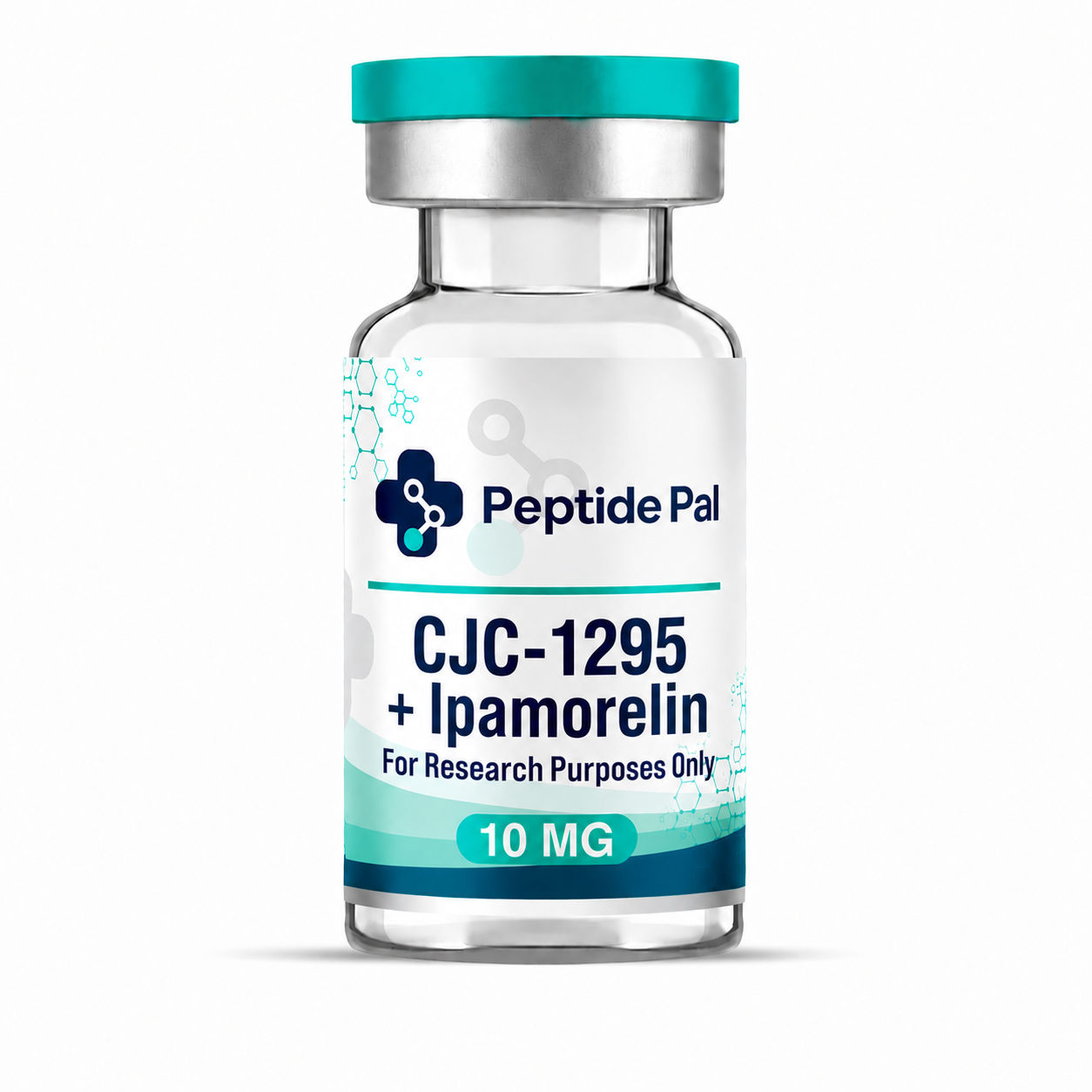
CJC-1295 + Ipamorelin

CJC-1295 + Ipamorelin

10mg / Vial
£40.00
Sale price  £40.00 Regular price 
Skip to product information
CJC-1295 + Ipamorelin

CJC-1295 + Ipamorelin

£40.00
Sale price  £40.00 Regular price 
Size
Type
For Research Purposes Only — Not For Human Use This product is intended solely for laboratory and in-vitro research. Not for human consumption, medical use, or self-administration.
CoA verified · every batch
1–2 day tracked dispatch
Discreet packaging
99%+ purity guaranteed
For Research Use OnlyThis compound is strictly for laboratory and in-vitro research. Not for human consumption or medical use.

This pairing represents the most researched GH secretagogue combination, activating growth hormone release through two distinct receptor pathways simultaneously. Human clinical data shows CJC-1295 produces 2–10 fold increases in GH with sustained IGF-1 elevation for up to 28 days. Ipamorelin adds precise GH pulse stimulation via the ghrelin receptor without raising cortisol — a key selectivity advantage confirmed in research. Studies demonstrate their combined use produces greater and more physiologically natural GH output than either compound in isolation.

Supplied as research-grade lyophilised peptide blend. Requires reconstitution with bacteriostatic water prior to use. For research purposes only.

Research Stack Builder

Build Your Research Stack

Curated combinations based on what researchers actually stack — backed by published data, priced to save.

Stack with CJC-1295 + Ipamorelin

SAVE £5

Why researchers stack these

  • 01GH axis covered via three distinct pathways
  • 02Direct tissue repair alongside GH elevation
  • 03Collagen synthesis completes the protocol
Full research context

CJC-1295 and Ipamorelin stimulate GH release through GHRH receptor and ghrelin receptor pathways respectively — producing synergistic GH pulses. BPC-157 and TB-500 are frequently added to study how GH elevation interacts with direct tissue repair signalling; many researchers observe amplified recovery when both systems are active simultaneously. Tesamorelin adds a third GHRH-based input for researchers studying sustained growth hormone patterns. GHK-Cu rounds out the protocol with collagen support and extracellular matrix repair.

Recovery & Repair Protocol

The most studied peptide combination for tissue repair, injury recovery & musculoskeletal healing

SAVE £5

Why researchers stack these

  • 01Non-competing structural repair pathways
  • 02BPC-157 angiogenesis + TB-500 satellite cell activation
  • 03GHK-Cu adds the extracellular matrix layer both lack
Full research context

BPC-157 and TB-500 are the two most frequently co-researched repair peptides in published literature, acting through complementary mechanisms — BPC-157 via nitric oxide pathways and angiogenesis, TB-500 via actin-sequestering and satellite cell activation. GHK-Cu rounds out the stack by supporting collagen synthesis and the extracellular matrix that both compounds do not directly address, while reducing the oxidative load that slows tissue recovery.

Metabolic & Body Recomposition

Most popular Peptide Pal stack — two non-competing fat loss axes with skin integrity support

SAVE £10

Why researchers stack these

  • 01GLP-1 triple agonism + GH axis — two distinct fat loss pathways
  • 02Skin integrity preserved throughout recomposition
  • 03Most purchased together on Peptide Pal
Full research context

Retatrutide and Tesamorelin address body composition through two non-competing mechanisms. Retatrutide's triple receptor agonism drives broad metabolic improvement and appetite regulation; Tesamorelin is FDA-approved for visceral adipose reduction through the growth hormone axis — a distinct mechanism. GHK-Cu supports skin integrity during recomposition; rapid fat loss without collagen support produces visible skin laxity that is far harder to address after the fact.

Cognitive Performance Stack

Neuropeptides studied for synergistic cognitive enhancement, focus & stress resilience — no sedation

SAVE £10

Why researchers stack these

  • 01BDNF stimulation balanced by GABA modulation
  • 02Focus without anxiety — three non-competing pathways
  • 03NAD+ fuels the neuronal energy demand
Full research context

Semax and Selank are registered pharmaceuticals with distinct mechanisms. Semax drives BDNF upregulation and cortical processing speed; Selank reduces the stress-induced cognitive interference that can blunt that effect, without sedation or dependency. NAD+ provides the cellular energy substrate that enhanced neuronal activity demands — researchers consistently report that this combination delivers balanced cognitive performance that neither compound achieves alone.

Skin & Glow Protocol

Collagen synthesis, antioxidant protection & melanin research in one comprehensive skin stack

SAVE £10

Why researchers stack these

  • 01Collagen, antioxidant & pigmentation — three skin pillars
  • 02Tyrosinase inhibition counterbalances MC1R agonism for pathway research
  • 03Structural integrity maintained alongside brightening
Full research context

GHK-Cu stimulates collagen synthesis and modulates over 4,000 genes involved in skin repair and inflammatory control — addressing the structural layer. Glutathione reduces oxidative stress and inhibits tyrosinase, producing measurable skin brightening with 30–35% tissue GSH increases confirmed in human RCTs. MT2 drives eumelanin synthesis via MC1R agonism, and researchers frequently combine it with Glutathione to study the interplay between melanocortin-driven pigmentation and tyrosinase inhibition simultaneously. Together these three represent the most comprehensive skin research protocol available.

Cellular Longevity Protocol

Three compounds that decline together with age — combined restoration for mitochondrial & cellular health

SAVE £10

Why researchers stack these

  • 01All three decline together with age — parallel restoration
  • 02Mitochondrial energy, AMPK signalling & antioxidant protection
  • 03Most complete cellular longevity protocol available
Full research context

NAD+, MOTS-c, and glutathione all decline measurably with age through parallel but distinct pathways. NAD+ restores sirtuin and PARP function essential for mitochondrial biogenesis and DNA repair — declining up to 50% by age 60. MOTS-c is the mitochondria-derived peptide that activates AMPK signalling and declines alongside NAD+; their combined restoration is the most researched longevity intervention. Glutathione provides the antioxidant protection that prevents cellular damage during the heightened metabolic activity that NAD+ and MOTS-c restoration drives — completing what researchers describe as the foundational cellular longevity triad.

Research & Studies

Peer-reviewed research supporting CJC-1295 + Ipamorelin

1 of 1

You may also like