


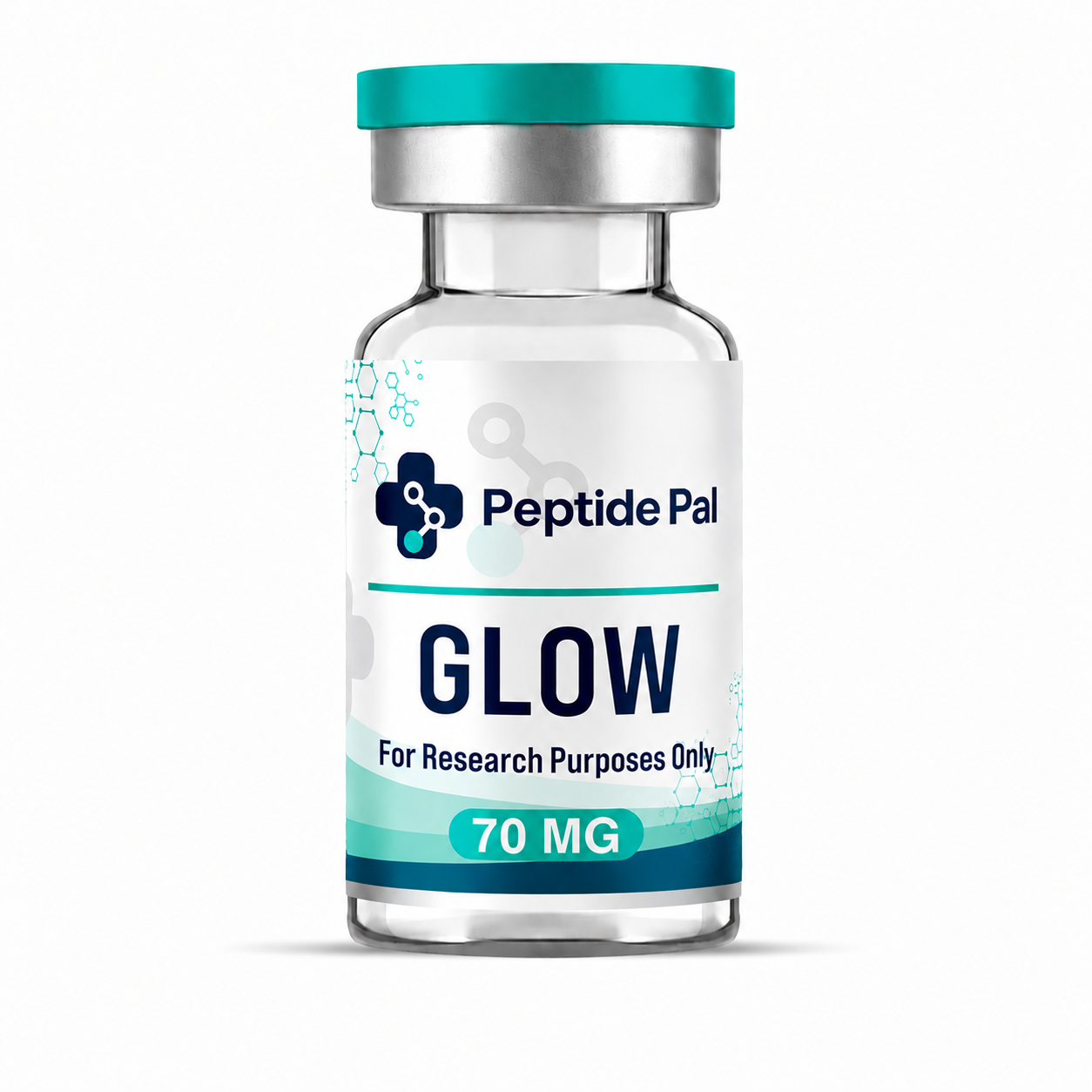
GLOW
70mg / Vial
£50.00
Sale price
£50.00
Regular price
Skip to product information
View the peer-reviewed research
Popular
GLOW
£50.00
Sale price
£50.00
Regular price
Third-party tested
1–2 day tracked dispatch
Discreet packaging
99%+ purity guaranteed
For Research Use OnlyThis compound is strictly for laboratory and in-vitro research. Not for human consumption or medical use.
Reconstitution
Pen format? Pens are supplied pre-mixed and ready for research use — no reconstitution required. The steps below apply to lyophilized vials only.
- Swab both vial stoppers with alcohol and allow to dry.
- Draw the required volume of bacteriostatic water with a sterile syringe.
- Add the water slowly down the inside wall of the vial — never directly onto the powder.
- Swirl gently until fully dissolved. Never shake.
- Confirm the solution is clear and particle-free.
- Label with date and concentration, then refrigerate at 2–8 °C.
Storage & Handling
- Lyophilized vials: refrigerate sealed at 2–8 °C away from light; freeze at −20 °C for storage beyond 6 months.
- After reconstitution: refrigerate at 2–8 °C; typically stable 4–8 weeks with bacteriostatic water. Do not freeze once mixed.
- Pre-mixed pens: arrive ready to use — refrigerate at 2–8 °C with the cap on and never freeze.
- General: avoid direct sunlight, heat and repeated temperature swings; minimise agitation.
Quality & Shipping FAQ
- Is this compound tested? Yes — every batch is third-party tested by accredited labs (HPLC & mass spectrometry) at 99%+ verified purity.
- How is it supplied? As lyophilized powder in a sealed sterile vial (or pre-mixed pen where offered), with research-use labelling.
- How fast is dispatch? 1–2 working day dispatch, 2–3 days UK delivery, in plain discreet packaging.
- What is it for? Strictly laboratory and in-vitro research — not for human or veterinary consumption, medical use or self-administration.
Packaging update
Our branded boxes are temporarily out of stock. Until new stock lands, orders ship in plain, discreet packaging — the same product inside, sealed and dispatched with the same care. Thank you for your patience.
GLOW Blend
GLOW is a Peptide Pal research blend combining three of the most widely studied peptides in tissue-repair and skin research — GHK-Cu, BPC-157 and TB-500 — in a single lyophilised vial for laboratory investigation.
What's in the blend
- GHK-Cu — a copper-binding tripeptide studied in dermatological and extracellular-matrix research.
- BPC-157 — a synthetic peptide studied in tissue-repair and growth-factor-signalling research.
- TB-500 — a synthetic form of Thymosin Beta-4's active region, studied for cell migration and actin regulation.
About
These three peptides are combined because they are associated with complementary research pathways, allowing them to be studied together in a single preparation.
Specifications
- Purity: 99%+ (third-party verified)
- Independently tested before dispatch
- Presented as lyophilised (freeze-dried) powder
- Supplied for in-vitro laboratory research only
FAQ
Is it tested? Yes — every batch is independently tested to 99%+ purity before dispatch.
What form does it arrive in? Lyophilised powder.
What is this sold for? Laboratory and research use only. Not for human or animal consumption.
⚖ For Laboratory Research Use Only — Not for Human Consumption.
